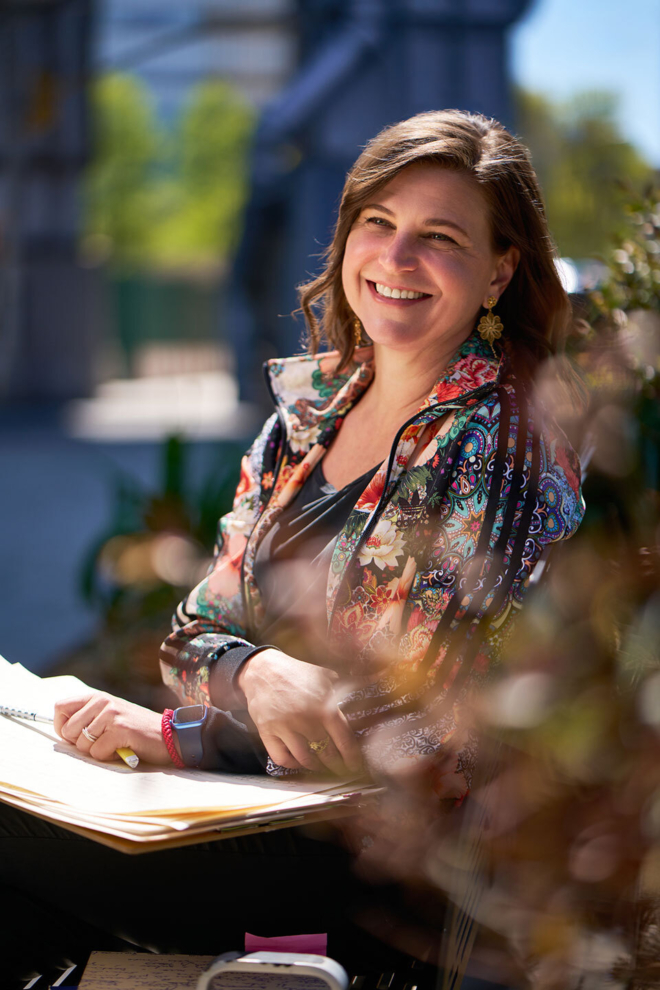
Lispector's story is about a young woman no one sees. The aimless, rootless Macabéa lives in the slums of Rio de Janeiro, making less than a living as an incompetent typist. Her boyfriend, the callous Olímpico, calls her a "starvation zombie." Yet Macabéa is not empty. "She's filled with all these literary observations about the world," Farrin says.
What she never has, until a moment in the opera, is a room to herself. "One side effect of poverty is that you never have any privacy," Farrin says. "I didn't understand how special it was that she was in a room by herself until I read this novel."
Alone, Macabéa cherishes her radio, a companion of sorts, which curiously plays "Una furtiva lagrima"—”a furtive tear,” Donizetti's tenor aria from L'elisir d'amore, around the clock. What comes out of the speaker isn't a recording: Farrin built an electronics part out of a recording of Enrico Caruso, altered beyond recognition. Macabéa doesn't recognize the piece or understand a word of it, yet begins to sob uncontrollably. "It's like a faucet was opened," Farrin says.
For most of the piece, Farrin keeps Macabéa’s part held back and mostly unsupported by the orchestra; once, she unleashes it in full-throated technicolor to sing “Furtiva.” “In the book, Macabéa says, 'I think I even know how to sing this,’” Farrin says. “The magic of opera is that I can give her the ability to sing it. She imagines that she's an opera star…she almost has her own karaoke machine. The orchestra is fully with her, supporting her fantasy. She fully gets to live that fantasy before it disappears.”
Daydreaming is also Macabéa’s escape from other people. In an office bathroom, her co-worker Gloria descends on her in chromatic rage over her sloppy work. Macabéa hears the low oboe notes of a snatch of "Una furtiva lagrima" again, then retreats from the conversation into language, fixing on the letter R over plodding figures in the strings.
“It's one of the darkest moments in the opera,” Farrin says. “They're in this bathroom together, the pressure is really on. [Macabéa] breaks a couple of times during the scene, but her final escape is through just the letter R. And it doesn't make any sense—she just clings to something, and it carries her off…it's almost like she's possessed by language.”
Macabéa's departures remind Farrin of something else entirely. "It's similar to the feeling I'd get from my grandmothers when they were possessed by domestic tasks, or artwork, or handicraft —a point of departure. It's a traveling in the mind," she says. One grandmother "used to make these super ornate crocheted worlds—I mean, they were insane, and she'd stay up till 4 in the morning doing it." The work looked like detachment, but was in fact "a very personal, liberated place, actually, in doing an act that was very not liberated."
She's written from that place before. The diamond in the square (2019) takes its title from a quilt pattern and puts a percussion quartet inside a piano—going to the piano, she says, "as if it were the stovetop, the meditative world.”
It's also why she fell for Macabéa, a character "who could lose herself in silly, mundane things and have profound thoughts in places that weren't a philosophy class, or a sermon, or a museum. It wasn't even a nature walk. It was in the kitchen."
"These were Macabéa moments," she says, "now that I understand it."
In the end, the escapes don't last. Macabéa dies in a random, needless way, foretold by a confused fortune-teller and met with the world's indifference. Passers-by don't even register the fantastical red of her blood, the one outward sign of an inner life no one noticed. Farrin marks the moment with a solo violin. She refers to “these unsaid things in the text—that we are part of why someone like Macabéa would die in such an anonymous way.”
“Maybe some people are hungry for a clearer message. I'm glad she didn't give it to us,” Farrin says. “They're very pointed questions. I think she knows what kind of answer she wants to get. She's got a hunch.”
In the novel, the entire story reaches us through Rodrigo, a slippery, self-absorbed narrator. Lispector chose a male narrator for the authority of his perspective, and Farrin gives that authority a sound: Rodrigo’s baritone moves in lockstep with the contrabassoon, cellos, and sometimes the bass voice.
The narration posed a dramatic challenge for Farrin. To set the text literally would mean a man alone on stage telling a woman’s story for an entire opera. And what a man: Rodrigo is conventionally masculine and a narcissist, ordering his housekeeper to fan him and firing her on a whim, and later being an abusive boss to Macabéa. At the same time, his internal complications—anxieties and guilt, and even a measure of compassion for Macabéa—keep us listening to him.
Farrin says, "The question was always: what do we do about Rodrigo?”
Her partner in resolving it was Sergio Chejfec, the Argentine writer and a close collaborator on the project. Farrin had wanted to ask him to write the libretto long before she did, and when she finally did, the connection was immediate: "He said it's his favorite book, and it's why he became a writer."
Chejfec found the answer. Instead of leaving Rodrigo a witness to Macabéa's death, they gave him a part in causing it. Farrin describes it as "just a slight switch from a total twist of fate to putting a hand on the scale." The shift to action puts his insecurities on stage. "He's using her," Farrin says. "He's trying to be alive, to feel some kind of power. He helps orchestrate this because he needs it."
Chejfec never heard the finished opera. He died suddenly in 2022; they had been in touch until a few hours before. “It was an intense personal loss for me and my family, and for the world—especially for Argentinian literature,” Farrin says.
Later, she wrote him a letter. This excerpt is about the evening they met:
You didn’t say much at that dinner, but you said something that I still think about every day: “Musicians don’t have to have good ears, but novelists do.” I could see the antenna come out of your bald head at that moment. Your eyes seemed wider. You always paid attention. Always.
After meeting you I read your book, Mis Dos Mundos [My Two Worlds]. I came to your talk with Saer and ran over to you afterwards to breathlessly tell you that I felt like I was reading from the inside of my own brain…You keep your tempo tranquilo. I am almost always agitato. I fill silences. You let them speak. I am here and you are not.
…Do you remember the big problem we had with the Clarice text? I went on thinking we’d never solve it and, a few years later, there it was. Your answer. You let the silence tell you.
…And now, from my writing desk. I visit you every day through your words. I hope I am doing a good job. I hope I am observing your silences.
Farrin says, “It's a personal reflection on having him with me this whole time but not having him here, and having guilt about that—not being able to celebrate this with him, not being able to talk to him, having an imaginary circle with me that I keep talking to. For the first half of this project I was worried about living up to Lispector, and then it shifted to really wanting to live up to Sérgio.”
Chejfec wrote the entire libretto in Rioplatense Spanish, his native language, and the Spanish Farrin speaks at home with her family. After he died, Farrin and colleagues adapted the text into Portuguese, the language of Lispector's novel. What's sung tonight is mostly Portuguese, with threads of Spanish and Italian, and the storyteller's part can be performed in the language of the venue. "The multilingualism is something that I incorporated as the project took shape," Farrin says. "I miss the original Spanish, which is why I left some in place for the character of Rodrigo, who remained Argentinian even though the libretto 'moved back' to Brazil."