Helmut Lachenmann
Essay by Donna Lee Davidson
“We are all pre-formed by our education, by our race, by our sex—by all the Things. We are not free. We are in a prison of all the conditions our living comes from”
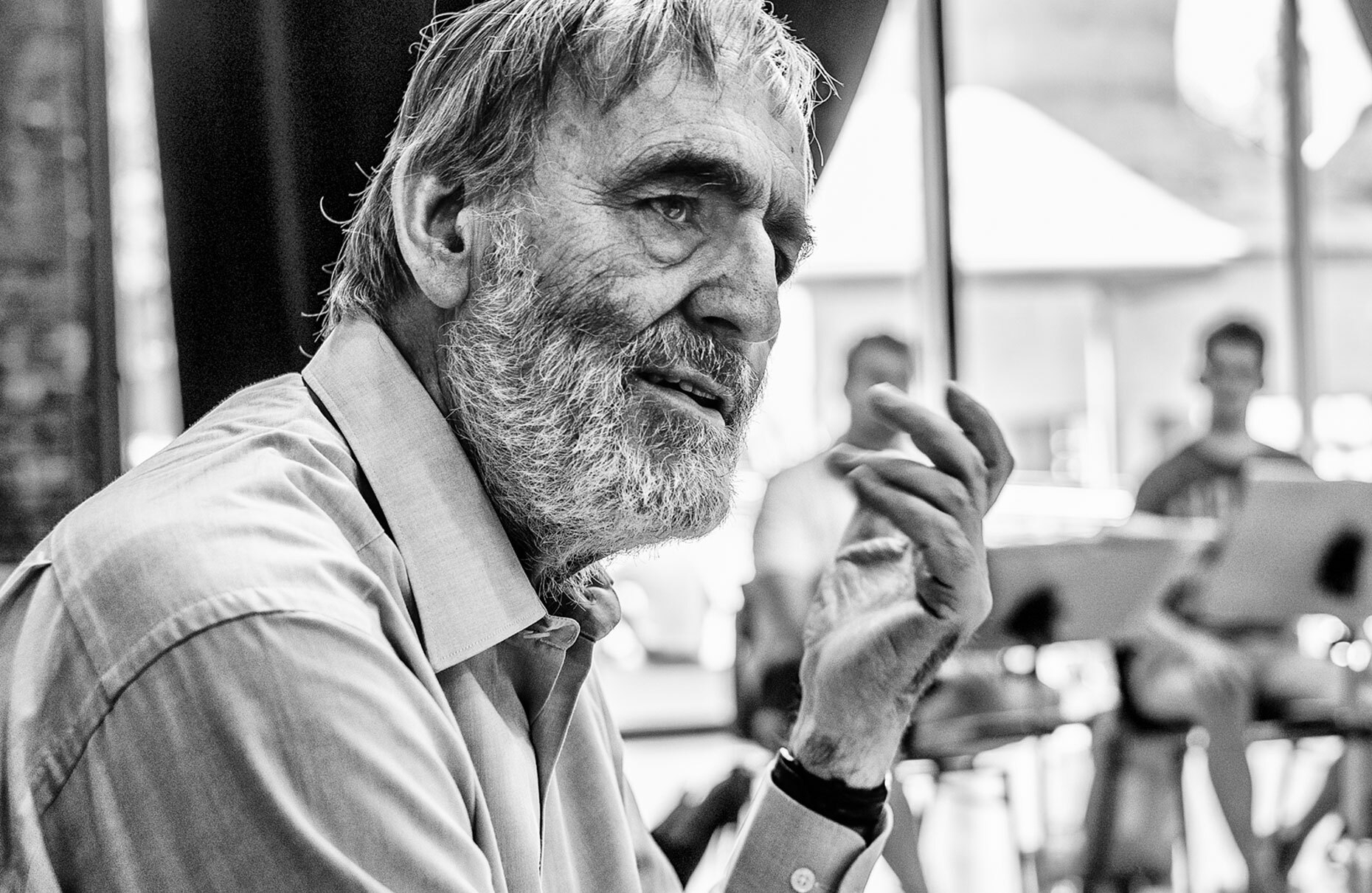
Donna Lee Davidson is an orchestral percussionist, jazz vibraphonist, educator, and music journalist. Her work has appeared in I CARE IF YOU LISTEN, The New York Times, and BOMB Magazine.
When violinist and composer Christopher Otto, one of the founding members of the JACK Quartet, saw Helmut Lachenmann’s (b. 1935, Stuttgart, Germany) music for the first time, he was “baffled,” he said in an interview over Zoom. Even as a student at the Eastman School of Music in 2003, the “vast majority of the piece used techniques [he] had never done” or even seen before. Between the confounding graphical symbols, the extensive not-yet-translated German instructions, and an entirely new clef—one for the right hand in addition to the left—in Lachenmann’s first string quartet, Otto remembered asking himself, “What am I doing? I’m learning an instrument for the first time.”
In kind, a question that could just as easily arrive for a first, second, or twentieth-time listener is, “what am I listening to?” Melody, harmony, and rhythm—the formation of music most recognizable to our ears—aren’t the preconceived categories we’ll hear tonight. It doesn’t mean they aren’t there. “There’s parts that he calls the waltz, the tango. Because it’s so radically different in sound, you don’t think, ‘oh that’s a tango or that’s a waltz’ but in his mind, at least, the rhythmic structure relates to that,” says Otto.
“Melody, harmony, and rhythm—the formation of music most recognizable to our ears—aren’t the preconceived categories we’ll hear tonight. It doesn’t mean they aren’t there.”
What it does mean, however, is that we, the listeners, right alongside the JACK Quartet and Lachenmann, have an opportunity to re-define, or un-define, those categories for ourselves.
“When I first encountered it, I didn’t know any of the theory behind it, or analysis, or have any concept of what he was doing compositionally. Why did he write those rhythms? I didn’t really get it; I still don’t really know,” Otto admitted.
Whether you’ve studied up on Lachenmann and his music or not (Otto has estimated he’s performed Gran Torso hundreds of times), it’s okay. The performers on stage are still working through it this very night, alongside us all. And even after two decades of performing this music, the JACK Quartet still works through it with Lachenmann. “It’s been over twenty years of slowly re-visiting these pieces. It’s a never-ending process, still, every time you play for him.”
The JACK Quartet and Lachenmann both recognize that this music is just as difficult to perform and compose as it is to listen to. In an interview this past June with Ensemble Modern magazine, also in celebration of his 90th birthday next month, Lachenmann accounts for both.
“Putting [extended techniques] into practice with such rhythmic precision and musicality forced some performers to be torn from their cherished habits. They felt both overwhelmed and that their professional pride was being undermined. They had no desire to embarrass themselves as more or less clumsy learners and feel ‘abused’ for having to perform technical tasks that had nothing to do with their understanding of music.”
Lachenmann was specifically discussing orchestral musicians and, truly, couldn’t be more accurate. However, “there were never any such problems with chamber musicians,” he added. “But,” he acknowledged, “they did occasionally find themselves facing horrified audiences!”
You might be horrified, or you might be enchanted–or perhaps feel nothing at all. No matter, is how Lachenmann puts it when confronted with the aesthetic appeal of his music. (“Some people love the fact that I keep denying and refusing, but others consider me a cowardly traitor to my own cause. No matter.”)
In addition to pitch, timbre, volume, and duration, “without doubt indispensable for the definition of an acoustically presented sound,” two more parameters—sound as a fixed state and sound as a process—are just as important, Lachenmann wrote in his 1966/91 essay “Sound-Types of New Music.”
Sound as a fixed state can be prescribed for a mood or a moment. It can be pre-packaged for commercial or ceremonial purposes. It can be pre-judged as worthy, or not. Essentially, it doesn’t overwhelm, embarrass, or abuse, meaning it also doesn’t challenge. It is known before it’s played. Its timbre, natural sustain and decay (how long a gong rings versus the pluck of a string), and harmonizations are all pre-formed according to the conditions our living comes from. The ringing of church bells and the singing of hymns can be among the most sublime sounds—paradisiacal—or the most ear-curdling, depending on one’s living conditions.
The three string quartets presented tonight are, literally and theoretically, a mixture of both, of fixed state and process, instrumentale musique concrète—a musical language coined by Lachenmann, in which how a sound is created is as important as the sound itself.
Lachenmann deals in sound as a process, negating the pre-judgement of it: the sound doesn’t exist until it’s created. Yes, entities claim authority over what non-existence is–always, and probably forever. But the actual Things themselves, the unstructured Things that fill non-existence (because it is not negative space)—those Things are untouched; they aren’t yet imprisoned. These quartets present more than just new types and structures of sound. “Process” presents that space between, linking non-existence into existence.
“For me, composing always means, if not solving a problem, then at least dealing with a trauma, full of fear/ pleasure,” Lachenmann wrote in 2010 about String Quartet No. 3 “Grido” (2001). “Compositional challenges to create a sounding situation that is, if not new to me, at least strange. I lose myself and thus find myself all the more.”
Grido is itchy but hardly scratches: a mixture, theoretically, of both fixed state and process—not new but strange— which makes it a good entry point for tonight’s concert. The fixed state of sound produced stays on the strings, where pitch is typically inevitable.
“This mixture of noise and pitch is a world where he really flourishes,” violist John Pickford Richards, another founding member of the JACK Quartet, said in an interview over Zoom. “Sometimes we’ll bow a wooden part of the instrument, or the bridge, or the peg, and it creates some kind of white noise or pink noise— pitchless noise—but then there’s a transition he makes where he introduces pitch very slowly into the sound.”
You’ll recognize, and can pre-judge, the sound of a bow’s hair on a violin string. But its sound in Grido, the strangeness of it, will make your pre-judgement wrong. Its harmonic-like quality isn’t harmonics. The chords screech, they itch, as though they’d pierce the eardrum but never truly achieve the scratching to do so. Its sound is on the cusp. Both sound as process and in the process.
“This mixture of noise and pitch is a world where he really flourishes.”
String Quartet No. 1 “Gran Torso” (1971) confronts, Lachenmann wrote, “a traditionally compromised sound apparatus.” There isn’t—theoretically—a mixture. “Tone and noise [are] not opposites,” but instead a broadening of sound categories. And while these categories have the usual parameters, Lachenmann’s focus is the “the bodily energetic.” Or another word, “it’s a German word—spirit; it’s so difficult to translate,” Lachenmann tried to explain in a 2023 lecture at the Sibelius Academy in Helsinki.
“As artists, we are the only ones who help people remember that we are creators with the possibility of spirit. The total of our intelligence, of our rational possibilities, has limits. [We] cannot understand everything by thinking. There’s something much more.”
If we could understand everything by thinking, there would be no need for art, or artists. We’d be dispensable. What Lachenmann is saying, and has said, is that artists “are totally indispensable.” Composers search for the sound, writers search for the words, dancers search for the movements, but these are all mediums for listeners, readers, and viewers (and the creators themselves) to reach and then search what might be irrational only because it’s beyond our intellectual limits.
Gran Torso opens with vertical shifts: instead of dragging the bow across the strings horizontally from left to right, the bow is irrationally played up and down, sounding the texture of the string itself rather than just the pitch produced by it. By pressing the wood into the hair of the bow, “the combination of the combined friction of the bow hair, the string, and the wood of the bow produces a dry, crackling grinding,” Lachenmann notated in the instructions. This produces what Lachenmann called “resistance” to his “poetics and sound syntax.” Resistance to “hearing and performance.” That is, resistance to listening—which, in every respect, is dangerous.
“Whenever a younger composer asks us to play a scratch tone without specifying anything else, we have to ask a bunch of questions—what type of scratch tone, we can demonstrate these thirteen different types of scrapes and squawks. Do you want something ugly, do you want something harsh, do you want something really refined?” Otto illustrated.
The new clef for the right hand Otto was shocked by, with over twenty-five new techniques at the time he learned it, is the sound by way of process. What was once merely pressed bowing contains a dozen different specifications. A scratch tone is no longer just one thing—harsh. Lachenmann’s music demands, through “irrational” sounds, more specificity. It demands going deeper.
Lachenmann “got us really engaged in the sounds and listening to music. I realized, ‘oh wow, this whole piece is totally different than I had thought.’ It wasn’t really about the brutal, ugly kind of sound. I mean, it had elements of that but it was much more refined and specific,” Otto said about learning Gran Torso for the very first time.
String Quartet No. 2 “Reigen seliger Geister” (1989) or “Round of the Blessed Spirits” broadens sound categories, the bodily energetic, even further—spirits in English now manifest as ghosts in German (Geist). Lachenmann neither wanted to abandon his innovations in the second quartet, nor did he want to use the same sound developments eighteen years later in the third. “It came down to how to proceed from there [Gran Torso] and this meant: go deeper,” he wrote in a 1995 analysis of Reigen. “Sound and form, sensory and spiritual experience meet.”
Pitch is drowned in toneless string noise, the breathy whispering that characterizes much of the sound. The polyphonic structure of restless and impulse-sounding techniques—sonic events that “become unwieldy in the course of the piece”—rip the internal rhythmic structure. When “the string quartet has become an imaginary guitar,” bows set aside, silence becomes its own sound, not negative space (just like non-existence), and yet rather than giving listeners a sonic reprieve, or release, it only tightens.
When he was elected Fellow of the Royal College of Music in 2010, Charles III (then Prince of Wales) was the College President. “Your music is difficult to understand,” he told Lachenmann. Aptly prepared, Lachenmann referenced a famous quote from William Shakespeare’s Hamlet. A play about a prince feigning madness that might not be feigned at all, depending on how his obsession to murder the king, his father, is measured.
“There is a method in my madness,” Lachenmann told the Prince, now King of England. Perhaps depending on the measurement, or no measurement at all— regardless, there is a method.
Ultimately, the challenge for listeners will be breaking free “of all the conditions our living comes from.” Herein lies the beauty of Lachenmann’s music and legacy.